
Showing posts with label subway. Show all posts
Showing posts with label subway. Show all posts
Sunday, December 5, 2010
Low Frequency Sketches
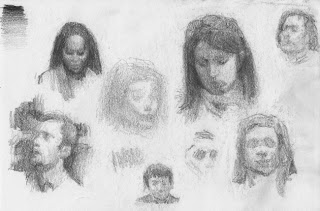
Recently I've become very interested in the idea of spatial frequency in relation to painting. As such, here are some sketches practicing low-frequency drawing. Most of these were done on the subway or Metro North.

Saturday, October 4, 2008
Subway Sketching & Perspective

Here's a quick one from the subway last night- just wanted to make some notes for myself about the process for this drawing.
- Draw the frame quickly to establish the plane of vision. Do your best to approximate the proportions of the scene you're trying to catch, but understand you'll probably have to change it later. Lately I've been finding it useful to do this for everything I sketch, since it reinforces the direction of view and thus the perspective. It also seems like good practice for composition.
- Establish the center of view- most importantly the horizon line. For me it seems to be a great benchmark since you can usually tell fairly accurately if something is at, above, or below your own eye level. This seems to be particularly true of people- maybe there's some evolutionary advantage to being able to tell if someone is taller or shorter than you. Sometimes I get tricked if I try to gauge their height by looking at their figure, but once I ask myself if their eyes are higher or lower than mine it becomes obvious. The same can be used for landmarks in the environment.
- Establish a vertical that will serve as your major "unit" for division. This will determine the scale of everything in your drawing, and how much will fit within the frame you've established. In this image, it was the edge of the subway door near the man. It seemed to be about twice the height of the seated man, which would allow me to get the whole corner of the subway car, which is what I was after.
- The vertical line in the step above seemed to have two approximately equal units above and below the horizon line , which helps to form the basis of a rough perspective grid. The line of the seats and the bottom of the overhead light should have equal (but inverted) angles in relation to the horizon line, and define the right vanishing point. The bottom of the seat defines the other vanishing point, and is reinforced by the the far wall.
- After this, the perspective grid is established and most everything is division. The most useful thing seems to be judging if something more than halfway or less than halfway between something else. On the subway, it almost never seems to be exactly halfway. The nice thing here is that even if your grid is inaccurate or intentionally from a different angle, as long as you divide the space from your initial big unit and continue to think in three dimensions it should end up working.
- There's occasional addition if you need to extend the big unit, but you have to set yourself up for division as soon as possible- once you add a couple things in a row it's easy to lose the relationships between everything and just focus on the particular element you're drawing at the moment. I often think of making another unit out on my big perspective grid- even if it goes off the page, and then dividing from there.
Thursday, February 22, 2007
Digital vs Traditional
Two more shots at the subway dreads girl:

This one's on the computer, obviously. Not done yet- the color is weird. But I explored some of the brush settings on Photoshop and was getting some interesting & good things to happen.

And this one is done traditionally. In acrylics even- and I hate acrylics. Though I made friends with it again a bit on this piece. This one was done faster & much more pleasantly than any of the digital ones. So I guess just keep going!

This one's on the computer, obviously. Not done yet- the color is weird. But I explored some of the brush settings on Photoshop and was getting some interesting & good things to happen.

And this one is done traditionally. In acrylics even- and I hate acrylics. Though I made friends with it again a bit on this piece. This one was done faster & much more pleasantly than any of the digital ones. So I guess just keep going!
Thursday, February 15, 2007
Learning To Paint in Photoshop

Seeing how far I can take a 2 minute sketch from the subway. This is my third shot- finally something is starting to happen that I'm pleased with. Still feeling clumsy in photoshop, but each try I learn a little something else. I think I can take this one a bit further still...
Subscribe to:
Posts (Atom)